
The Allocator’s NotebookJohn R. Kamprath, CFP® | Marie E. Kamprath |
Vol. 2, No. 2.1
August 21, 2026 |
3Q2026 Mid-Quarter Update
Allocating Alongside “The Machine”
Last month we wrote about the modern market structure. We walked through “The Machine” — our research partner Hedgeye’s term for the systematic, rules-based trading that now drives the overwhelming majority of daily market volume — and contrasted it against Benjamin Graham’s and Warren Buffett’s timeless principles: Mr. Market and your circle of competence, owner mindset, and margin of safety. We used that framework to explain our own full-cycle, signal-driven approach to portfolio construction, and closed with a discussion of the choppy first-half 2026 environment, including the drawdowns our “go anywhere” portfolios experienced despite resilient headline index levels.
In today’s mid-quarter update, we examine our growth portfolio and some of the rebalances we have made to it since our July missive. In brief, we have achieved both a broadening of the overall holdings as well as a reduction and shift in specific sector and thematic allocations.
A Broadening in Profits and a Broadening in Portfolio Holdings
As 2026 unfolds, a broadening in US profit margins is occurring. Where 2025 saw a concentration in profit margin growth for the seven largest US companies (the Magnificent 7, or “Mag7” stocks), 2026 has changed course and thousands of companies with less than a trillion dollars of market capitalization are accelerating their profit margins. Note: margin growth is often a significant factor for stock price appreciation.
(See “Trend → Broadening Margin Improvement.” exhibit)
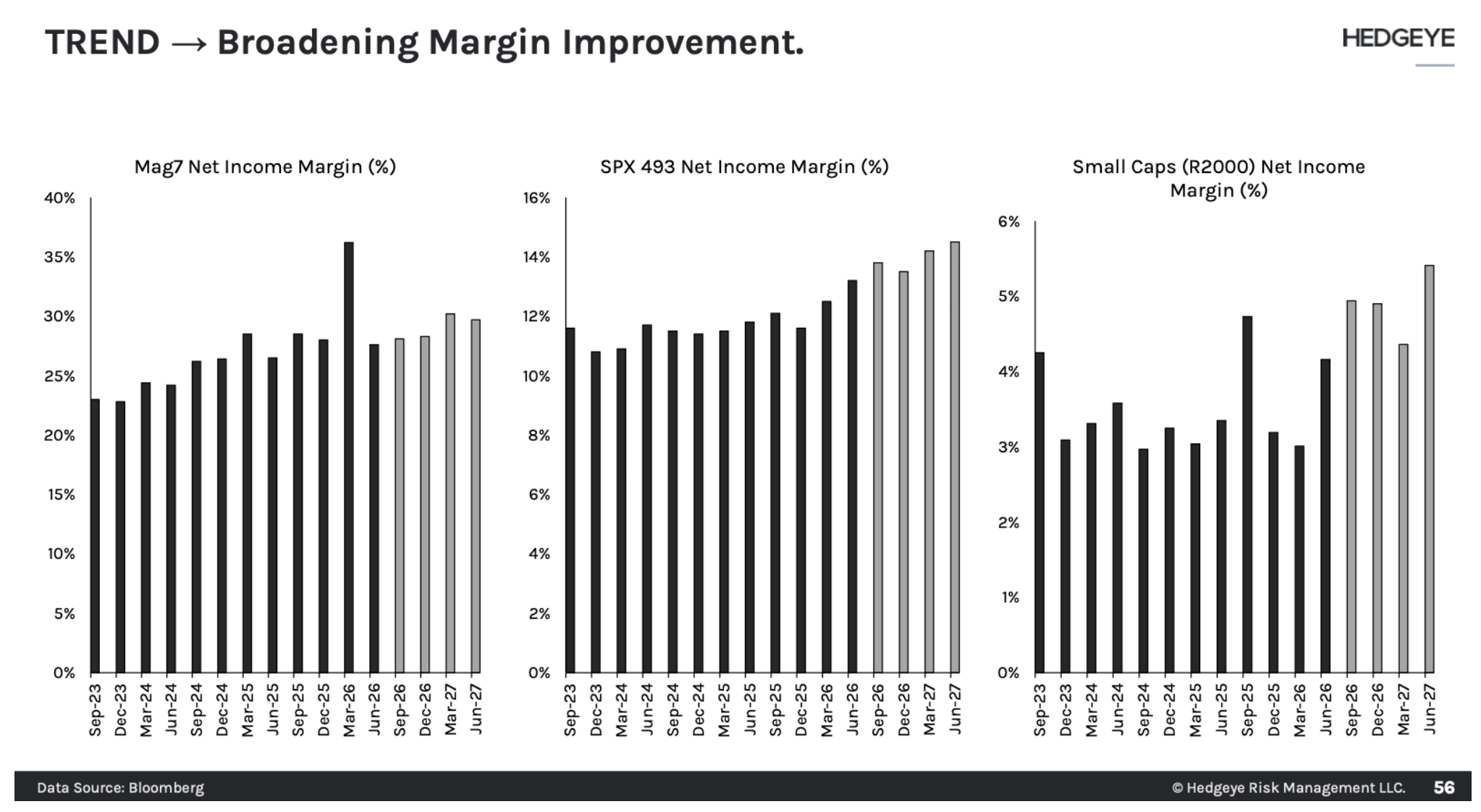 How are our portfolios positioned to participate in this broadening of company profitability?
We are allocating large positions to exchange traded funds that (1) own an equal weighting of the companies within the stock index they emulate (e.g., $RSP – Invesco S&P 500 Equal Weight ETF); and (2) have lower volatility when compared to their broad indices as a whole (e.g., $USMV – iShares MSCI USA Minimum Volatility Factor ETF; $LVHI – Franklin International Low Volatility ETF).
“Buy Gold, Wear Diamonds” (a Steve Hanke-ism)
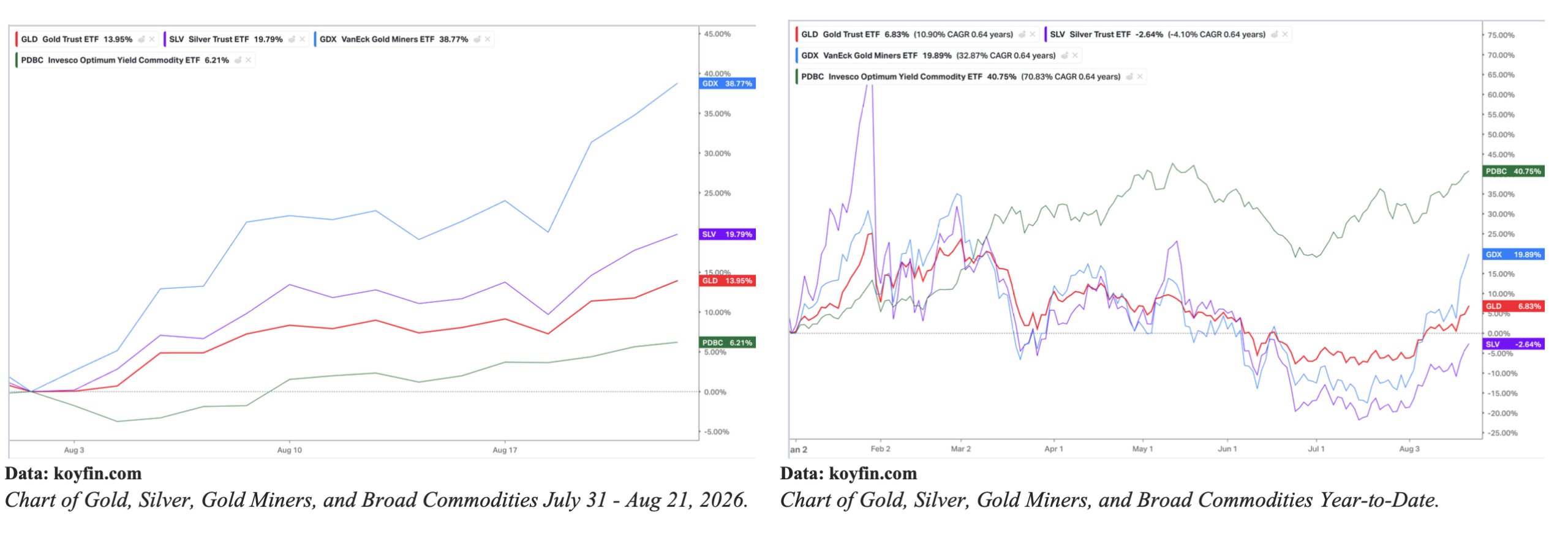
A further development since the end of July is the rally in things precious and just plain “stuff”: gold, silver, their mining companies, and – more recently – broad commodities.
After a banner upwards cycle from November 15, 2024, through January 28, 2026, both for gold ($GLD: +109%) and silver ($SLV: +283%), these metals corrected significantly this year from their January peaks through mid-July ($GLD: -26% & $SLV: -52%). The price, volume, and volatility signals we observe suggest that gold and silver have made the turns from severely bearish to neutral (July), and, now in August, bullish. Bottoming is a process, and identifying it requires both data and artful judgment. We took significant profits this January and February — for investors who were with us in 2025 — and less handsome ones in March and June. Now we are building gold and silver positions again and adding gold miners and broad commodities to the mix.
Data: koyfin.com
Chart of Gold, Silver, Gold Miners, and Broad Commodities July 31 – Aug 21, 2026.
What Else?
The single stocks we owned have fluctuated widely in value with sustained trends being few and far between. Consequently, we reduced the number of such positions and are not looking to add more until such time as trends confirm.
We are looking at the “AI™!” revolution through a lens which seeks to identify long-term winners. As Chairman Mao sings in the opera Nixon in China, “Founders come first, then profiteers!” We’re concerned that same pattern may play out in today’s AI buildout. When bubbles deflate, the (yet-to-go-public) Artificial Intelligence companies — along with the chipmakers and memory-circuit providers supplying them — risk becoming little more than commodity labor in someone else’s value chain, worn down by their own overbuilding. Meanwhile, many companies believed to be headed toward obsolescence may in fact prove to be key anchor businesses in the new AI economy.
Noteworthy is the rebound that software companies have experienced recently. At the start of the year, “SaaSpocalypse” was the dominant narrative. This story line held that software providers and platforms (SaaS = Software as a Service) from Adobe ($ADBE) to Manhattan Associates ($MANH) to Microsoft ($MSFT) to Salesforce ($CRM) were headed toward extinction. It was widely believed (and markets priced in) that AI will replace these bastion workhorses of industry, logistics, and management. Reflecting upon historical disruptive buildouts (i.e., bubbles) from the railroads to the internet, investors, like Rick Rule, are seeing parallels: AI may ultimately become a thin-margined utility upon which savvy service providers (read: trusted, proven software innovators) grow and expand value both for their customers and shareholders. We are holding software companies with signal strength that are exploiting advances in AI and compute such as GlobalX Cybersecurity ETF ($BUG); Defiance Quantum Computing ETF ($QTUM); iShares Expanded Tech-Software Sector ETF ($IGV); and ROBO Global Robotics and Automation Index ETF ($ROBO).
About Generational Legacies Wealth Management, John R. Kamprath, and Marie E. Kamprath
Saeculum LLC is an investment adviser domiciled in Idaho. We operate under the trade name Generational Legacies Wealth Management (Firm). John R. Kamprath, CFP® is the Firm’s President and Chief Allocator. Marie E Kamprath is the Firm’s Director Operis (Operations). This missive shall not be directly or indirectly interpreted as a solicitation of investment advisory services to persons of another jurisdiction unless otherwise permitted by statute.
| The Allocator’s Notebook
Vol. 2, No. 2.1 | August 21, 2026 |
Tel: (208) 299-0400 | www.GenLegacies.com |